
BlogsGuide
Coffee Tables Buying Guide: How to Choose the Right Size, Shape and Material for a UK Living Room
The right coffee table sits about two-thirds the length of your sofa, leaves roughly 40–50 cm of clear space between the seat edge and the table, and is low enough that you can reach a drink without leaning. Get those three numbers right and the rest — shape, material and storage — becomes much easier to decide.
This guide is about choosing a coffee table that fits how a UK living room is actually used: tight walkways, radiators, TV sightlines and the gap in the middle of a corner or double-chaise sofa. It is not a compact-room glass-table roundup — that sits in a separate small-room furniture article. Here we walk through sizing first, then shape, then material, then storage and nesting, before you browse the coffee tables range.
How big should a coffee table be?
Start with the sofa, not the catalogue photo. Measure the length of the main seat run you will place the table in front of. As a working rule, aim for a table that is around two-thirds of that length. A 210 cm sofa usually looks balanced with a table somewhere near 120–140 cm long; a compact two-seater can take something closer to 80–100 cm.
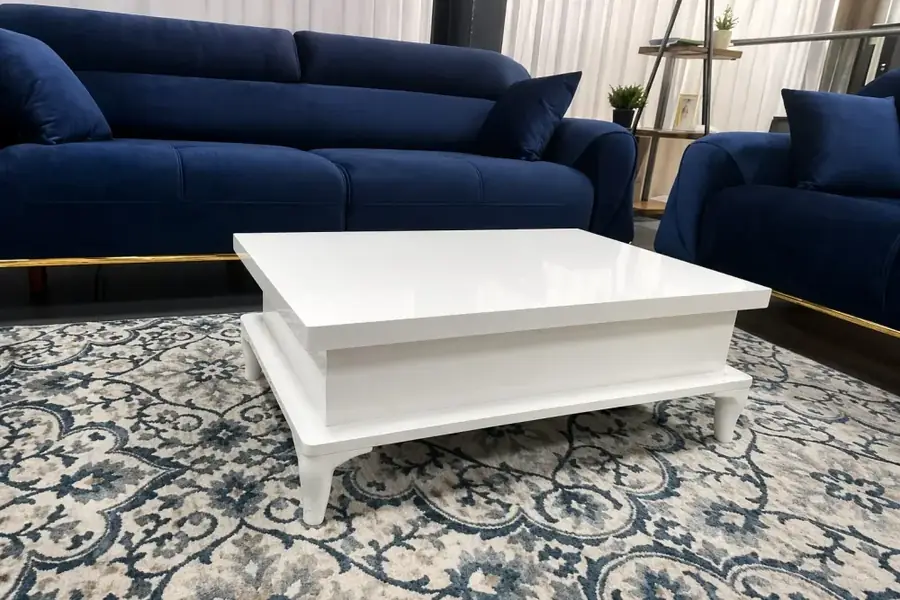
Height matters as much as length. Most coffee tables sit between about 35 cm and 45 cm high. Our full white coffee table with storage is listed at 36 cm high (88 cm wide and 58 cm deep), which tucks neatly under many sofa arms. The Carre black glass coffee table sits taller at about 45 cm high, with a larger top of roughly 122 cm by 61 cm — a better match for a longer sofa where you want more surface.
- Leave roughly 40–50 cm between the front of the seat cushions and the nearest edge of the table so knees and feet have room.
- Keep a walkway of about 75–90 cm wherever people need to pass the table to reach a door, radiator or TV unit.
- If the table has drawers, a lift-up lid or nesting pieces that pull out, allow extra clearance on the opening side.
- Tape the outline on the floor for a day. It is the quickest way to spot a table that would block a walkway or sit too far from the sofa.
Round tables are measured by diameter rather than length. A round top of about 80 cm — the size listed for the Luzzo round black glass coffee table — suits a compact seating group or the centre of a U-shape without hard corners catching shins.
Round, rectangular or nesting: which shape fits your room?
Rectangular tables give you the most continuous surface for trays, remotes and a laptop, and they line up cleanly with a straight sofa. They work well in longer rooms where the seating runs along one wall.
Round tables soften a room and are kinder in tight walkways because there are no sharp corners. They also sit naturally in the middle of a corner layout or double-chaise seating, where everyone faces inwards. If you already have a large double-chaise sofa, check the seating footprint carefully; the table in the middle still needs that 40–50 cm gap all round.
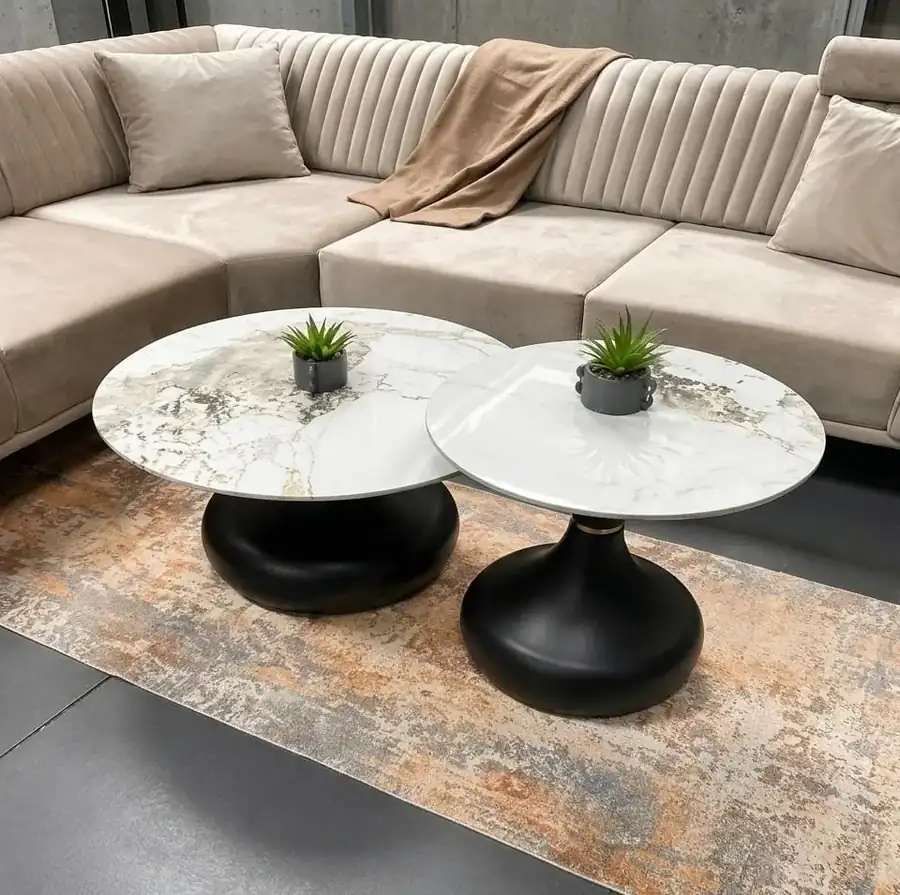
Nesting sets give you flexibility. A round marble coffee table set of 2 lets you keep one table in the centre for everyday use and slide the second out when guests arrive, then tuck it away again so the walkway stays clear. That is especially useful in terraced and semi-detached lounges where floor space is limited but you still want a proper surface when entertaining.
Glass, marble or solid: choosing a material
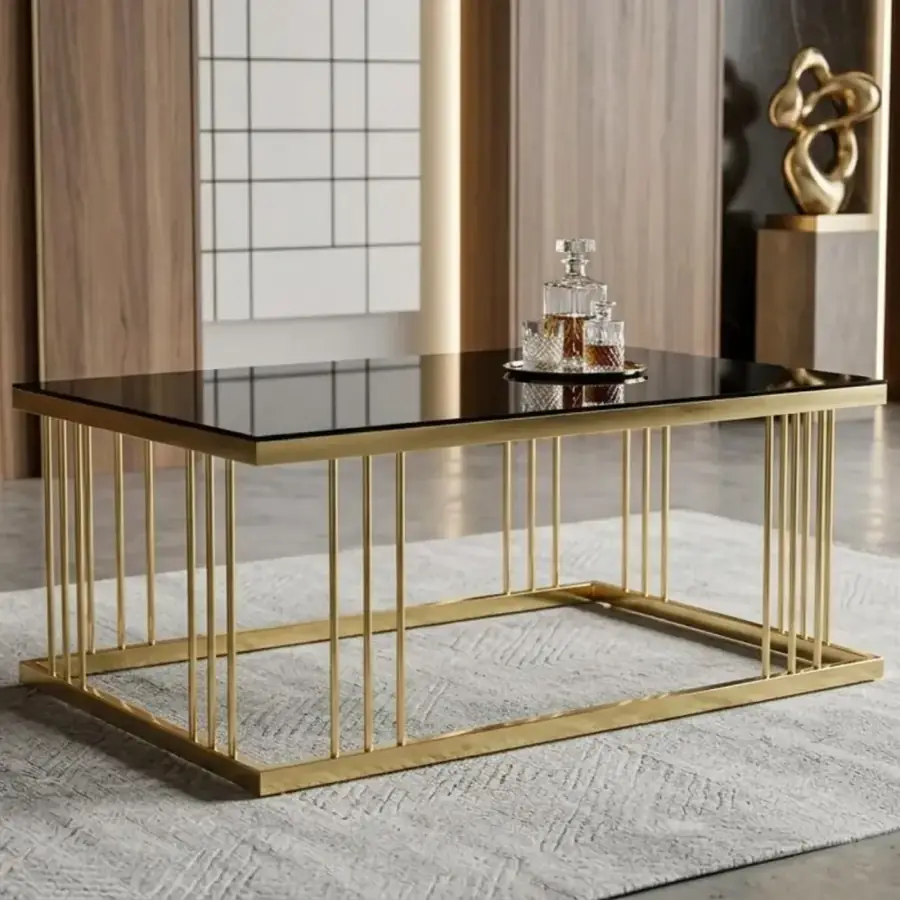
Glass tops keep a lounge feeling open because you can see the rug and floor underneath. A black glass top with a gold or silver metal frame reads as modern without adding visual weight — the Carre design is a clear example of that look. Glass does show fingerprints and needs coasters; it is also worth thinking about homes with very young children, where a rounded edge or a nesting set you can pull back from the main walkway may feel safer.
Marble and marble-effect tops add a stronger focal point. They suit living rooms where the coffee table is meant to be noticed, and they pair well with velvet sofas and darker metal frames. Use coasters and wipe spills promptly; natural and effect tops both mark more easily than people expect.
Solid or wrapped tops in white, grey or wood tones are the everyday workhorses. They hide more clutter visually, feel warmer under a mug, and often come with built-in storage. Choose a finish that works with your flooring and sofa rather than fighting them — mid-grey and soft white are the most forgiving in busy family rooms.
Storage coffee tables vs open designs
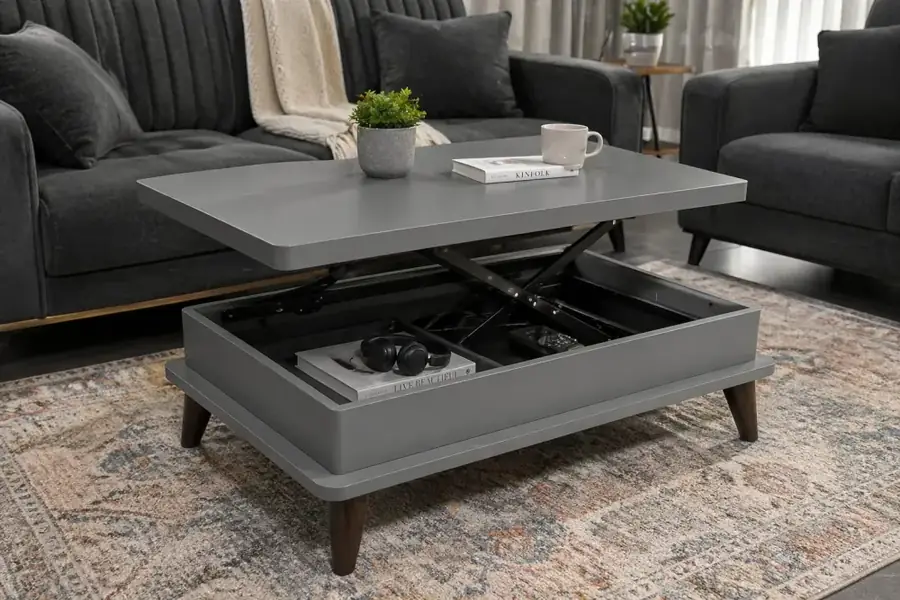
If remotes, magazines and charging cables live permanently on the tabletop, a storage design will tidy the room more than any tray. A grey storage coffee table with a hidden compartment keeps those bits within reach of the sofa but off the surface. The full white coffee table with storage does a similar job in a brighter finish, at the compact 88 × 58 cm footprint noted above.
Open designs and simple glass tops suit rooms that already have a sideboard or TV unit for clutter. They look lighter and are quicker to dust. Nesting tables sit between the two: the main top stays clear, and the extra surface only appears when you need it.
When you compare storage models, check how the compartment opens. Lift-up tops need clear space above and in front; drawers need space to pull out without hitting the sofa. Measure that motion as carefully as the closed footprint.
Fitting a coffee table around your sofa layout
A straight two- or three-seater is the simplest case: centre the table on the sofa, keep the 40–50 cm knee gap, and leave a clear path to the door. In open-plan rooms, the table also helps define the seating zone so the lounge does not blur into the dining area.
Corner layouts and double-chaise seating need a table that sits in the middle of the seats, not pushed against one section. Round or nesting shapes usually look more balanced here than a long rectangle, because people approach the table from more than one side. If the seating is large, check that the table still leaves a comfortable gap on every seat edge — the same measuring advice from our U-shaped sofa buying guide applies to the table in the centre.
Do not forget radiators, bay windows and the TV. A table that forces people to walk between the screen and the sofa every time they cross the room will become annoying within a week. Sketch the walkways before you order.
Common mistakes to avoid
- Buying a table that matches a photo but not your sofa length — oversized tops crowd a small lounge; tiny tops look lost in front of a large corner or U-shape.
- Ignoring height. A very low table can be hard to use from a deep sofa; a tall one can block sightlines and feel awkward for drinks.
- Forgetting opening clearance on storage and nesting designs.
- Choosing pale high-gloss finishes for a busy family room without planning for coasters and regular wiping.
- Skipping the delivery route. Even a coffee table can be awkward on tight turns in a terrace hallway, so check the boxed size on the product page if access is tight.
Conclusion
Choosing a coffee table is mostly measuring: sofa length, knee gap, walkways and how the top will be used day to day. Once those are clear, shape and material follow naturally — round or nesting for multi-sided seating, glass when you want the room to feel open, marble when you want a focal point, and storage when clutter is the real problem.
Browse the full coffee tables range to compare dimensions side by side, or start with the pieces linked below. If you are still settling the sofa itself, the U-shaped sofa buying guide and our small space furniture ideas guide are useful companions to this one.
FAQs
Aim for roughly 40–50 cm between the front of the seat cushions and the nearest edge of the table. That gives most people room for knees and feet while still keeping drinks within easy reach.
A practical starting point is a table about two-thirds the length of the sofa. Pair that with a height around 35–45 cm, then check the listed width and depth on the product page against the clear floor space in front of your seats.
Often yes, because there are no sharp corners on the main walkway and a round top sits neatly in the middle of corner or double-chaise seating. Nesting round sets are especially useful when you only need the extra surface some of the time.
Glass can work if you choose rounded edges, use coasters and keep the table out of the main run between door and sofa. Homes with toddlers sometimes prefer a nesting set that can be pulled back, or a solid storage table with softer corners.
Buy storage if remotes, magazines and cables usually end up on the tabletop. An open glass or marble top is better when you already have somewhere else for clutter and want the room to feel lighter.
UK Furniture Online offers 14-day returns with a collection charge. Measure your sofa gap and walkways carefully before ordering, and email info@ukfurnitureonline.co.uk if you need help reading a product’s dimensions. Our warehouse address is 20 Fairhaven Street, Manchester M12 5EE.